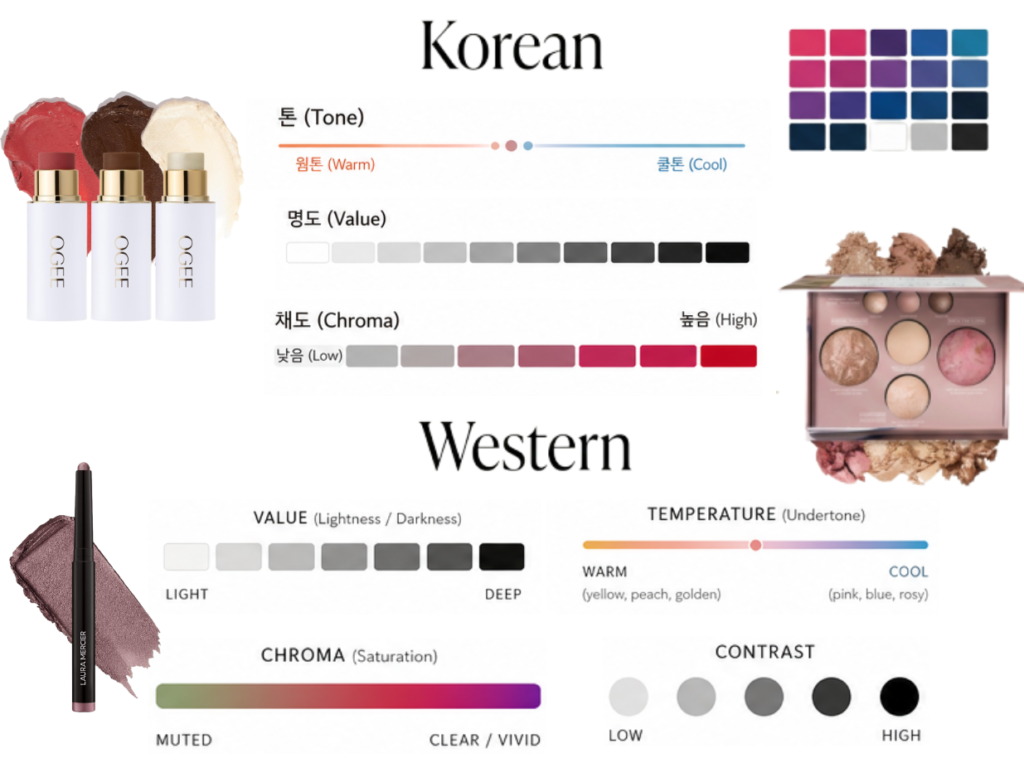
Korean personal color analysis and Western seasonal color analysis are two approaches to the same underlying idea: that certain colors harmonize with a person’s natural coloring more than others. They share the same core dimensions, temperature, value, and chroma, but differ in emphasis. Western analysis is organized around the twelve-season system and tends to apply broadly across wardrobe, hair, and styling. Korean analysis is organized around facial harmony and skin clarity and tends to apply most directly to makeup and everyday beauty decisions. Neither is more accurate than the other; Colormaxxing combines both.
Two Systems, One Underlying Idea
If you’ve spent time researching personal color, you’ve probably noticed the content splits into two distinct flavors. One uses season names, Spring, Summer, Autumn, Winter, and talks about wardrobes and palettes. The other uses phrases like “facial harmony” and “skin clarity,” and talks about foundation shades and lip colors.
It’s natural to wonder if you’re supposed to pick one. You’re not. Both are describing the same underlying color theory from two different angles, and understanding both gives you a more complete picture than either one alone.
Where the Two Systems Come From
Western seasonal color analysis has roots going back decades, growing out of what is now well documented as the Western seasonal framework’s origins, built around the idea that a person’s natural coloring aligns with the qualities of an actual season, warm and clear like Spring, cool and soft like Summer, warm and rich like Autumn, cool and high-contrast like Winter. Over time, this expanded from four broad seasons into twelve more specific subtypes.
Korean personal color analysis developed as part of a broader beauty culture with a strong emphasis on skin clarity, complexion harmony, and practical, everyday beauty application. Rather than centering the season name, it centers the direct visual question: does this color make your face look more vibrant and balanced, or does it create dullness and unevenness.
Both systems ultimately rest on the same four dimensions: temperature (warm or cool), value (light or deep), chroma (clear or muted), and contrast (how different your hair, skin, and eyes are from one another). The dimensions aren’t in competition. The two systems simply built different structures on top of the same foundation.
Where They Overlap
- The same core dimensions. Warm versus cool, light versus deep, clear versus muted: both systems evaluate these, even when the vocabulary differs.
- The same underlying goal. Both aim to identify colors that create visual harmony rather than colors that are objectively “good” or “bad.”
- Both reject rigid rules. Neither tradition, applied well, treats a season or a facial-harmony result as a restrictive checklist. Both describe a direction, not a cage.
- Both improve with practical application. Neither system is meant to stay theoretical. Both exist to make real decisions, what to buy, what to wear, what to put on your face, easier and more confident.
Where They Diverge
- Primary application. Western seasonal analysis tends to be applied broadly: wardrobe, hair color, accessories, and makeup all get organized under one season. Korean personal color analysis tends to concentrate most heavily on makeup, skincare, and anything worn close to the face.
- Structure. Western analysis organizes everything around the twelve-season system, a fixed set of named categories. Korean analysis is more fluid in structure, often working color by color, asking “does this specific shade create harmony” rather than starting from a season label.
- Entry point. Western analysis often starts with the question “which season am I.” Korean analysis often starts with the question “which of these colors makes my face look clearest,” and may arrive at a season-like conclusion afterward, or may not use season language at all.
- Cultural context. Korean personal color analysis developed within, and remains closely tied to, Korean beauty culture, where facial clarity and complexion harmony are central beauty values reflecting a well-documented cultural trend. Western seasonal analysis developed within a broader fashion and styling tradition.
| Western Seasonal Analysis | Korean Personal Color Analysis | |
|---|---|---|
| Core structure | Twelve named seasons | Direct color-to-face comparison |
| Primary application | Wardrobe, hair, styling, makeup | Makeup, skincare, complexion |
| Typical entry question | “Which season am I?” | “Which color makes my face clearest?” |
| Best used for | Building a full-wardrobe color direction | Fine-tuning makeup and beauty choices |
Why Colormaxxing Combines Both
Treating these as competing systems misses the point of either one. Western seasonal analysis gives you a well-organized structure for your overall coloring, useful when you’re building an entire wardrobe or trying to understand your general direction. Korean personal color analysis gives you a sharper, more immediate tool for the products you interact with daily, your foundation, your blush, your lipstick.
Used together, they cover more ground than either does alone: a season to organize your bigger decisions, and a facial-harmony lens to fine-tune the smaller, closer-to-your-face ones. This is why Colormaxxing was built around combining Korean and Western approaches rather than choosing a side.
Practical Application
- When building a wardrobe, the Western seasonal system’s broader palette structure tends to be the more useful starting point, since it’s designed to organize a wide range of colors across many garments.
- When choosing makeup, the Korean approach’s direct comparison method, holding a shade against your actual skin and watching for clarity versus dullness, tends to give faster, more confident answers than trying to reason from a season name alone.
- When in doubt, use both. Start with your season for general direction, then use the Korean method’s direct comparison test on any specific product before buying it.
Common Misconceptions
- “They contradict each other.” They don’t. They emphasize different parts of the same underlying color theory.
- “One is more scientific than the other.” Both rest on the same established principles of temperature, value, chroma, and contrast; neither has a stronger claim to being “more scientific.”
- “You have to choose one system to follow.” You don’t. Many people, and the Colormaxxing approach itself, use both together.
Key Takeaways
- Korean and Western personal color analysis share the same core dimensions: temperature, value, chroma, and contrast.
- Western analysis is organized around the 12-season system and applies broadly to wardrobe and styling.
- Korean analysis is organized around facial harmony and applies most directly to makeup and skincare.
- Colormaxxing combines both because they cover different, complementary parts of the same picture.
Frequently Asked Questions
Neither is a required starting point. If you want a broad wardrobe direction, start with the Western season system. If you want immediate makeup guidance, start with the Korean facial-harmony approach.
They shouldn’t, since both are measuring the same underlying dimensions. If a mismatch appears, it’s usually a sign that lighting, photo quality, or a specific product’s exact undertone needs a second look, not that the systems disagree in principle.
They developed within different cultural and historical contexts rather than one simply being a newer version of the other. Our guide to The History of Seasonal Color Analysis covers the Western tradition’s background in more depth.
No. Colormaxxing’s AI analysis and educational content draw on both traditions intentionally, rather than treating one as primary and the other as supplementary.
Where to Go From Here
To see the Korean approach explained fully on its own terms, our guide to Korean Personal Color Analysis Explained is the natural next read. If you’d rather start with the Western structure, What Is Personal Color Analysis? and What Are the 12 Seasons? cover that foundation.
And when you’re ready to see both approaches applied to your own coloring at once, our free Personal Color Analysis, powered by AI, draws on principles from both systems in a single result.