
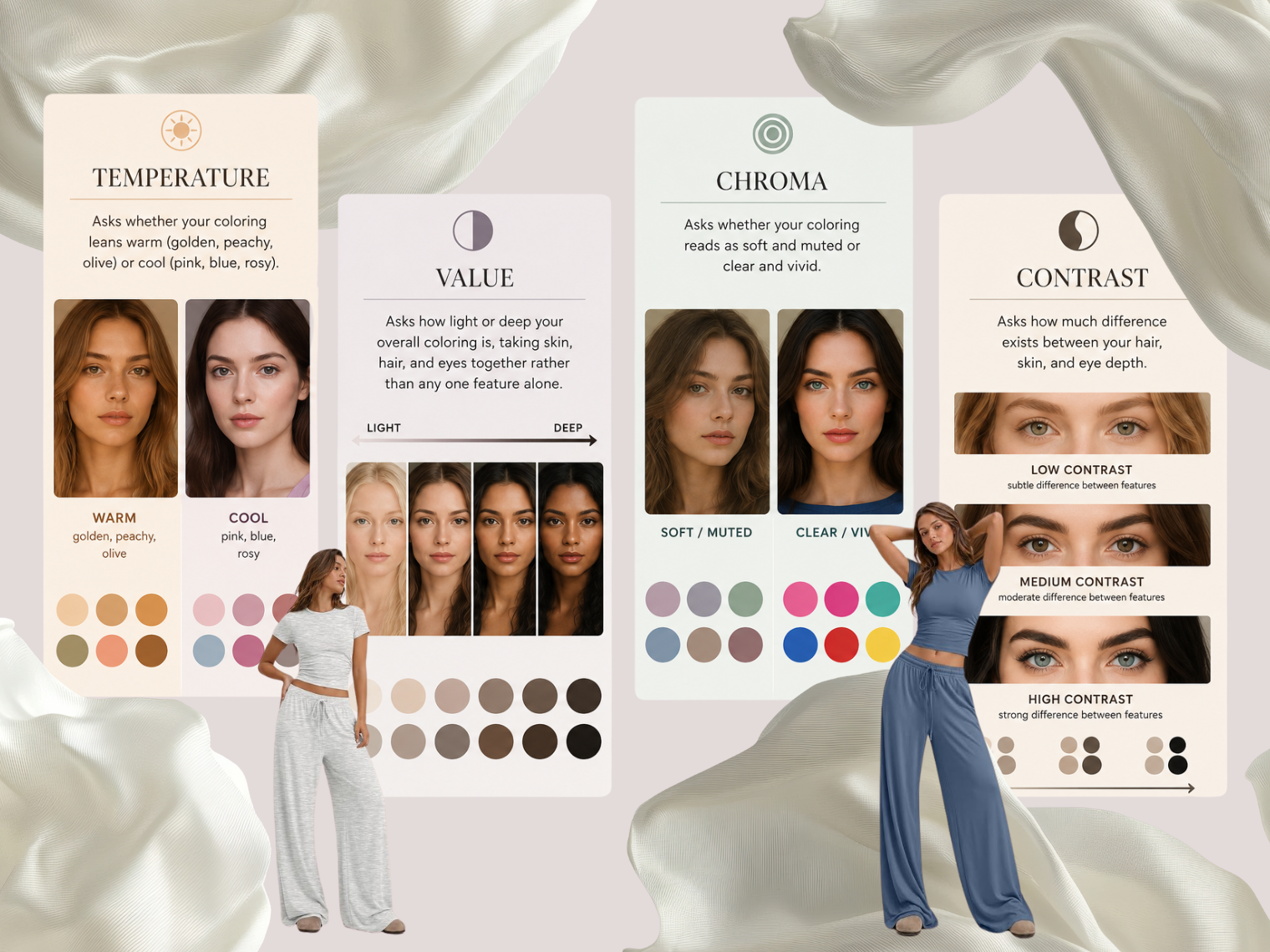
Personal color analysis works by evaluating four qualities of your natural coloring at the same time: temperature, value, chroma, and contrast. Instead of measuring these one by one, an analysis looks at how they combine to form your overall pattern, then matches that pattern to the season it harmonizes with most. This can happen through self-assessment, an in-person draping session, or an AI photo analysis.
The Question Nobody Quite Answers
You’ve read that seasons exist. You might even suspect you already know yours.
But the actual mechanics tend to stay vague. Is someone holding up fabric to your face? Is it a quiz? Does a computer look at a selfie and just know?
All three, actually, depending on the method. What stays consistent underneath all of them is what’s being measured and why. Once you understand that part, the method you choose stops mattering as much.
The Four Qualities, Working Together
Personal color analysis doesn’t look at any single feature in isolation. It looks at how your skin, hair, and eyes work together, then evaluates that combination against four qualities.
- Temperature asks whether your coloring leans warm (golden, peachy, olive) or cool (pink, blue, rosy).
- Value asks how light or deep your overall coloring is, taking skin, hair, and eyes together rather than any one feature alone.
- Chroma asks whether your coloring reads as soft and muted or clear and vivid.
- Contrast asks how much difference exists between your hair, skin, and eye depth.
None of these are scored separately and then added up. A real analysis holds all four in mind simultaneously, because they interact. A warm, deep, muted, low-contrast person and a warm, light, clear, high-contrast person can share the same undertone and still belong to entirely different seasons. Temperature starts the conversation. The other three qualities decide where it ends.
The Three Common Ways an Analysis Happens
Self-Assessment
This is the most accessible starting point, and the one most people try first. You compare your own coloring against reference examples: warm versus cool fabrics held near your face, light versus deep color families, muted versus vivid tones.
Self-assessment works best as a starting direction rather than a final answer. It’s genuinely useful for narrowing down warm versus cool, which is often the clearest signal to read on your own. Value, chroma, and contrast can be harder to judge without a comparison point or a trained eye, simply because you’re working from memory of what “vivid” or “muted” looks like rather than a side-by-side reference.
Professional Draping
Draping is the traditional method behind seasonal color analysis, with roots going back to the color-season framework popularized in the 20th century (you can read more on the history of seasonal color analysis on Wikipedia). A consultant holds different fabric swatches near your face, in natural light, and observes how each one affects your appearance in real time: does your skin look brighter or duller, do shadows soften or deepen, does the color sit in harmony with you or compete with you.
This method is valuable because it’s dynamic. You can see the shift happen fabric to fabric, which makes the four dimensions feel concrete instead of theoretical. Its main limitation is access: a trained consultant isn’t available to everyone, and sessions typically require scheduling and cost.
AI Photo Analysis
AI analysis evaluates your coloring from one or more photos, using the same four dimensions a trained eye would look for, applied consistently across thousands of reference points. You upload a photo taken in even, natural lighting, and the analysis identifies your temperature, value, chroma, and contrast pattern from there.
The appeal is accessibility: no appointment, no cost barrier, available whenever you’re curious. Photo quality matters more here than with draping, since lighting and camera color accuracy directly affect what the analysis can see. That’s the one variable worth controlling carefully if you go this route.
None of these three methods is “more correct” than the others. They’re different ways of answering the same question, and many people end up using more than one, starting with self-assessment, then confirming with a draping session or an AI analysis once they want more precision.
Why the Process Isn’t Just “Check Your Undertone”
It’s tempting to assume undertone alone settles the question. It doesn’t, and this is where a lot of self-assessment goes sideways.
Two people can both be warm-toned and still land in completely different seasons, because value, chroma, and contrast haven’t been factored in yet. A warm, light, soft, low-contrast person often aligns with Light Spring or Soft Autumn. A warm, deep, clear, higher-contrast person often aligns with Deep Autumn. Same starting point, different destination, because the process is evaluating the whole pattern rather than one piece of it.
This is also why a five-second undertone quiz rarely feels fully accurate. It’s answering a fourth of the question.
What This Looks Like in Practice
If you want to try a version of this yourself before going further, here’s roughly how the four dimensions translate into something you can actually observe:
- Temperature. Hold something clearly golden-warm near your face, then something clearly blue-cool. Notice which one makes your skin look more even and which one looks slightly harsh or grey against you.
- Value. Compare a very light, soft color against a very deep, rich one. Notice which one feels proportionate to your overall coloring rather than washing you out or overwhelming you.
- Chroma. Compare a bright, saturated color against a soft, muted version of roughly the same hue. Notice which one your face seems to keep up with versus which one seems to fade next to it.
- Contrast. Think about how close in depth your hair, skin, and eyes actually are. Low difference generally points toward softer, blended color combinations. Noticeable difference generally points toward being able to carry bolder, more defined combinations.
None of this needs to happen all at once, and none of it is a final verdict. It’s a way of building intuition for what a full analysis is actually evaluating.
Common Mistakes During Self-Assessment
- Judging color under artificial or yellow-toned lighting. Warm indoor bulbs can make cool colors look warmer than they are, and vice versa. Natural, indirect daylight gives the most accurate read.
- Testing only one dimension. Checking warm versus cool and stopping there answers a quarter of the question, which is why so many people feel half right about their season.
- Comparing yourself to someone else’s result. Two people with similar skin tone can still land in different seasons once hair depth, eye color, and contrast are factored in.
- Expecting an instant, obvious answer. Some people see a clear shift immediately. Others need to compare several options before the pattern becomes visible. Both are normal.
Key Takeaways
- An analysis evaluates temperature, value, chroma, and contrast together, not one at a time.
- The three common methods are self-assessment, professional draping, and AI photo analysis, and none is inherently more accurate than the others.
- Undertone alone answers only one of the four questions a full analysis asks.
- Natural, even lighting matters more than almost any other variable in getting a reliable read.
Frequently Asked Questions
A professional draping session typically takes 60 to 90 minutes. An AI photo analysis usually takes a few minutes once you have a suitable photo. Self-assessment can be as quick or as thorough as you make it.
You can get a reasonably reliable starting direction, especially for temperature. Value, chroma, and contrast are harder to judge without a comparison reference, which is where draping or an AI analysis tends to add the most value.
Yes. Warm artificial lighting, dim rooms, and heavy shadows can all distort how a color reads against your skin. Natural, indirect daylight gives the most reliable result for any method.
They’re different tools measuring the same four dimensions. Draping offers a trained eye and real-time observation. AI analysis offers consistency and accessibility. Many people find either approach gives them a usable, confidence-building starting point.
Personal color analysis is interpretive, not absolute. If a result doesn’t feel right, it’s worth revisiting with better lighting, a second method, or simply holding the recommended palette against your favorite pieces to see how it feels in practice.
Where to Go From Here
Now that you know what’s actually being evaluated, the next natural step is seeing how those four qualities combine into the seasons themselves. Our guide to What Are the 12 Seasons in Personal Color Analysis? walks through exactly how temperature, value, chroma, and contrast combine into each of the twelve.
And if you’d rather skip straight to a result, our free Personal Color Analysis, powered by AI, uses this same four-dimension framework to identify your season from a couple of photos.